
The industry of shipping fine art is, we’d say, pretty niche and is definitely quite specialised. But it has a nice, interesting origin story.
Art dates back to as far as the beginning of human culture on Earth – drawings on cave walls, hieroglyphs carved into stone that combine the perfect blend between language and art. As the years have gone on and human culture has continued to evolve, to develop, so, therefore, have the different methods for shipping fine art.
Learn more about the journey of fine art.
The Earliest Example of Art Transport
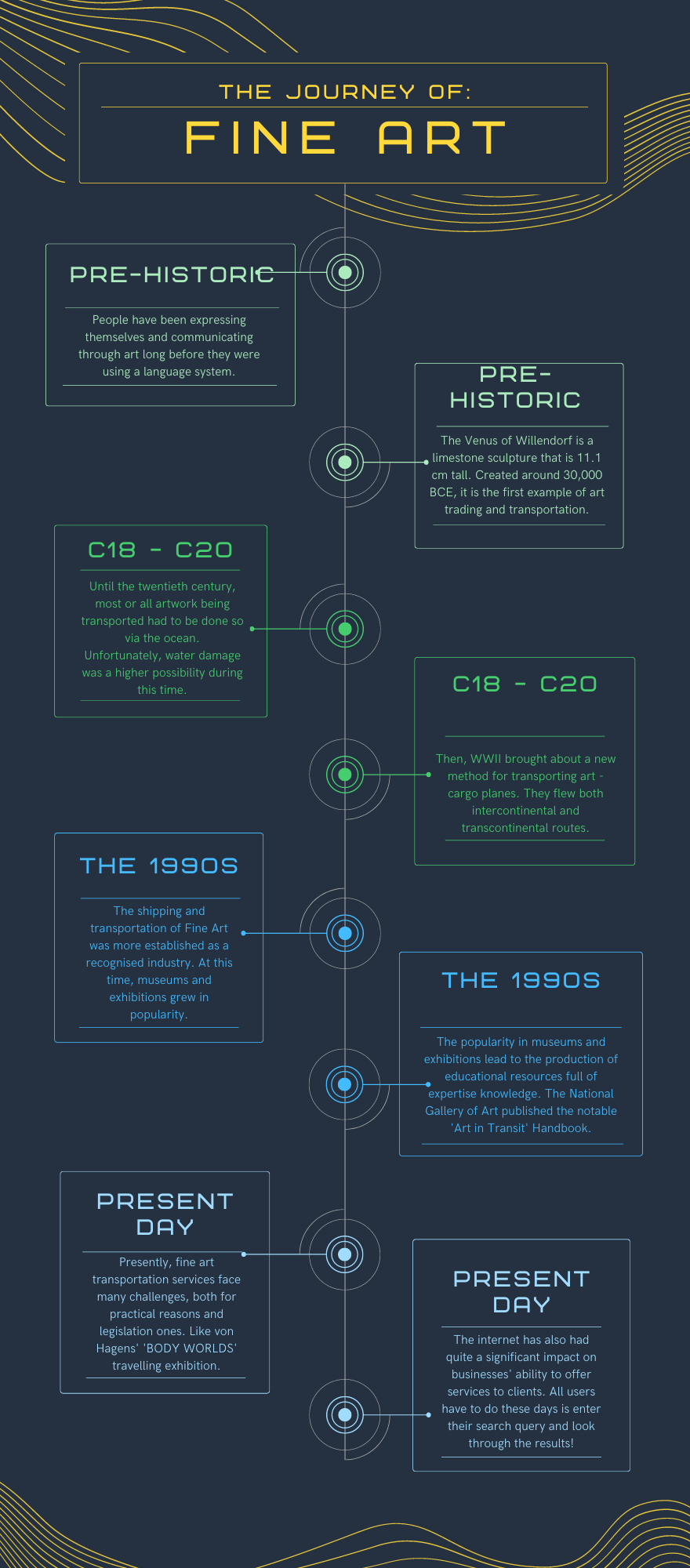
Pre-historically, people were expressing themselves and communicating through art long before they were conversing using language systems. And of course, in those ancient times, art shipping wasn’t necessarily shipping but rather trading. As was (and still is) the way of the world.
Ancient and transient communities would participate in trading art works and then transporting them. ‘The Venus of Willendorf’ limestone sculpture, standing at 11.1 centimetres tall, is one of the first recorded examples of art transportation. This figurine, with its red ochre pigment, is assumed to have been carved somewhere around 30,000 BCE in Palaeolithic Europe.
Presumably, it was carried around by its owner.
The 18th to 20th Centuries
Until the 20th century, most, if not all, artwork had to be transported across the ocean. Unfortunately, this means that the fine art was often subjected to possible water damage, temperature and humidity changes.
But then, World War II brought a new and alternative method for shipping those irreplaceable fine art paintings. Cargo airlines that flew both transcontinental and intercontinental routes. Plus, transport by air was quicker and safer than by ocean.
Approaching the 1990s
As we approached the 90s, the shipping and transportation of Fine Art became much more established as a recognised industry. Art exhibitions and museums became increasingly popular and the museums needed Fine Art. Thus, Fine Art transportation companies started popping up.
Following this, educational resources and expertise knowledge were produced for both the purpose of protecting and safely transporting any fine art. It comes in the form of a guide – the Art in Transit: Handbook for Packing and Transporting Paintings published by the National Gallery of Art is one of the more notable ones.
Present Day
Presently, fine art transportation services face many challenges both practically and due to legislations. For instance, von Hagens has a travelling exhibition known as ‘Body Worlds’ which is an exhibition that displays fragile pieces of real human anatomy. It is creations of this nature that present unique challenges for art handlers.
The internet has also had a significant impact on the ability to offer services to clients as well. In fact, all users have to do is search a query and several pages of relevant services and service providers will show up.
Our Services
Do you have irreplaceable and fragile fine art paintings that you want help transporting? If you have any other kinds of fine art, our transportation services extend to those, too! And other types of art transportation.
Everything is professionally handled by us and that includes packing your fine art before it gets transported in one of our custom vans.
Trust Aardvark Art Services
Aardvark Art Services is a reputable transportation service that is expert and professional. If you need your pieces moving from point A to point B, you can trust us. We’ll make sure your art is transported safely, sustaining no damage and hassle-free.
Just get in touch with the team for more information about our fine art shipping services.